


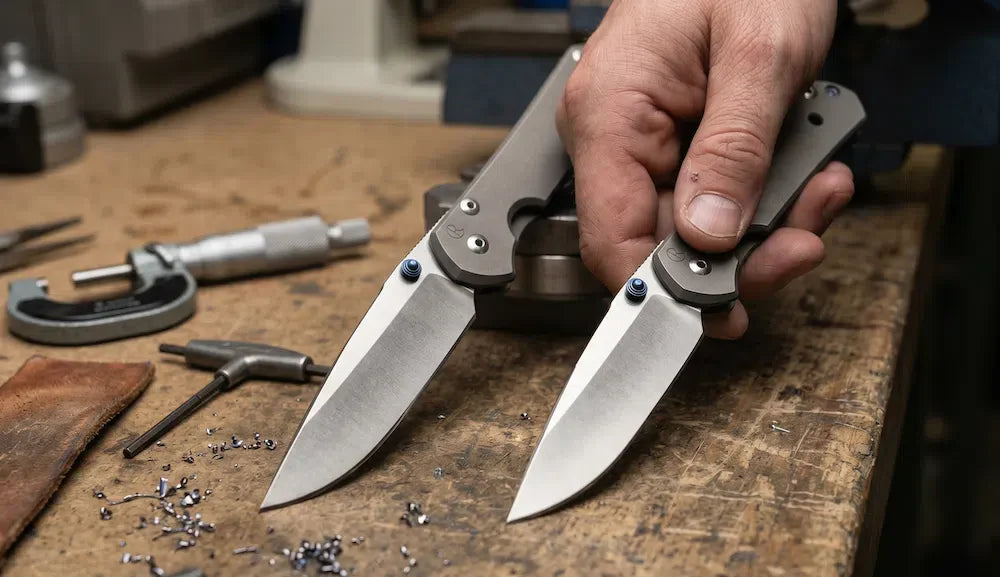
In the world of Everyday Carry (EDC), we often obsess over blade steels, Rockwell hardness, and handle ergonomics. Yet, one of the most critical interfaces between the user and the tool is the humble thumb lug (commonly referred to as a thumb stud). It is the primary "gatekeeper" of a folding knife’s deployment.
Whether you are deep in the woods or managing a busy storefront, the way a knife opens defines its utility. Today, we’re diving into the history, mechanics, and the ongoing debate between Single vs. Double Lugs, with a special look at how brands like Chris Reeve Knives have turned this small piece of hardware into a legendary design element.
1. The History and Importance of the Knife Lug
Before the 1980s, if you wanted to open a folding knife, you usually needed two hands. The "nail nick"—a small groove in the blade—was the standard. While functional for a traditional slipjoint, it was slow and required fine motor skills that vanished the moment your hands were cold, wet, or gloved.
The Shift to One-Handed Deployment
The transition to the modern "tactical" or "one-handed" folder changed everything. Makers like Bob Terzuola and brands like Benchmade (then Pacific Cutlery) began experimenting with ways to allow the thumb to deploy the blade without assistance from the other hand.
The thumb lug was a revelation. It allowed users to keep one hand on their task—whether holding a rope, a piece of timber, or a fishing line—while the other hand deployed the tool. This mechanical necessity paved the way for the robust modern folding knives we carry today.
Why the EDC Community Cares
In the EDC community, the lug is more than a tool; it’s part of the "manual of arms." The placement, height, and texture of a lug determine:
-
Deployment Speed: How quickly the blade can be engaged.
-
Reliability: Whether your thumb will slip off the stud under pressure.
-
The "Fidget Factor": Let’s be honest—the tactile "snick" of a well-tuned lug is half the fun of owning a high-end folder.
2. The Purpose: Single vs. Double Lugs
At its core, the lug provides leverage. By placing a stud near the pivot point of the blade, the user can apply outward pressure to overcome the detent (the mechanism that keeps the knife closed) and swing the blade into the locked position.
The Single Lug: Minimalist Efficiency
A single lug is located on only one side of the blade (typically the "show side" for right-handed users).
-
The Advantage: It creates a cleaner aesthetic and reduces the profile of the knife in the pocket. Because there is no stud on the back side, it is less likely to snag on your pocket seam or other gear.
-
The Downside: It is inherently biased. If you are a right-handed user and you injure your hand—or if you find yourself in a position where you must use your left hand—a single-sided lug becomes an obstacle rather than an asset.
The Double Lug: Ambidextrous Versatility
A double lug features studs on both sides of the blade. This is often achieved by a single threaded post that passes through the blade or two separate studs pressed in.
-
The Advantage: True ambidexterity. Whether you are left-handed, wearing heavy gloves, or holding a piece of equipment in your dominant hand, the double lug ensures the knife is always ready.
-
The "Pinch" Opening: Double lugs also allow for a "pinch" opening, where you use your thumb and middle finger to rotate the blade open slowly and securely—a preferred method for those who value precision over speed.
Is it Preference or Performance?
| Feature | Single Lug | Double Lug |
| Aesthetics | Clean, asymmetrical | Robust, balanced |
| Versatility | Optimized for one hand | Fully ambidextrous |
| Pocket Snag | Minimal | Slightly higher risk |
| Maintenance | Easier to clean around | Can trap lint on both sides |
For most, it is a matter of preference. However, for those who use their knives in "real-world" conditions—ranching, security, or emergency services—the double lug is often seen as a performance upgrade.
3. The Gold Standard: Chris Reeve Knives (CRK)
When discussing lugs, you cannot ignore Chris Reeve Knives. The Sebenza and the Inkosi are often the benchmarks by which all other thumb-stud folders are measured.
The CRK Philosophy
Chris Reeve’s approach to the lug is unique. Unlike many production knives that use "flickable" studs designed for speed, CRK lugs are designed for intentionality. They are typically conical, often anodized in a striking blue or gold, and placed with mathematical precision to maximize leverage for a "slow roll" opening.
The Double Lug Upgrade
Standard Sebenzas often come with a single lug. However, the Double Lug option is one of the most requested upgrades in the CRK catalog.
-
Why users love it: On a CRK, the double lug provides a sense of symmetry that matches the "over-engineered" feel of the titanium scales.
-
Utility in the Field: Given that many CRK owners use their knives for everything from office tasks to heavy outdoor work, the double lug offers peace of mind. If you're out on the water or in the field, you don't want to be "locked out" of your knife because your dominant hand is occupied.
Technical Precision
The CRK lug is heat-treated and pressed with such tight tolerances that it essentially becomes part of the blade's geometry. While some brands use "bolt-on" studs that can loosen over time, a CRK lug is built to last the lifetime of the knife.
4. Conclusion: Summary and Recommendations
The choice between a single or double lug might seem like a minor detail, but it dictates the entire user experience of a folding knife.
Summary
-
Single Lugs are for the minimalist who wants a sleek, snag-free carry and primarily uses their dominant hand.
-
Double Lugs are for the pragmatist. They offer total ambidexterity and ensure the tool is functional in any situation, regardless of which hand is available.
-
The Community has largely shifted toward preferring double lugs on high-end pieces because they add value and versatility without a significant weight penalty.
Recommendations
-
For the Professional: If your work involves multitasking (holding tools, gear, or livestock), go with the double lug. The ability to deploy your blade with your "off-hand" is a safety feature you’ll eventually appreciate.
-
For the Collector: If you appreciate clean lines and the "show" side of a blade, a single lug provides a classic look that highlights the grind of the steel.
-
For the Lifetime User: If you are investing in a "grail" knife that you intend to pass down, consider the Chris Reeve Knives collection. Opting for the double lug ensures that the knife remains perfectly functional for any future owner, regardless of their dominant hand.
Ultimately, a knife is a tool meant to work for you. Whether you prefer the streamlined profile of a single stud or the "always-ready" nature of the double lug, the most important factor is that you can deploy it safely and instinctively when the moment arises.
Share:
Ultimate Freshwater Tackle: Deep Dive into Lures for Ponds and Rivers
Gear Review: The Agawa Canyon Boreal21 Folding Saw